How to lay out a closet: rods, shelves, drawers and shoes
The short answer
Count what you own, then give each kind its own space: double hang for shirts and trousers, one long-hang cabinet for dresses and coats, drawers for what folds, and shoe shelves for shoes. Put what you use every day between your knees and your shoulders.
- Double hang (Rod over Rod) doubles the hanging on the same wall: two bars with 37-3/8″ clear under each, 41-11/16″ at 92-5/8″ tall.
- For dresses and long coats you need one long-hang cabinet: up to 64-3/4″ clear at 84″, 73-3/8″ at 92-5/8″.
- Measure your own longest piece on its hanger. That one number decides your long-hang cabinet.
- Rods sit at a fixed height. Shelves and shoe shelves move on their pins, whenever you like.
Start with what you own
Before you pick a single cabinet, look at what will go in the closet and sort it into five piles:
- Short hanging: shirts, blouses, jackets, skirts, and trousers folded over a hanger.
- Long hanging: dresses, long coats, robes, and trousers hung full length.
- Folded: sweaters, jeans, t-shirts, workout clothes.
- Small things: socks, underwear, belts, ties, accessories.
- Shoes, and the bags and boxes that end up on the floor.
For the hanging piles, push the hangers together and measure how many inches of rod they take. That tells you how much bar you need far better than counting pieces. Then leave some room to spare: a packed rod is a closet nobody puts things back in.
How a closet cabinet is divided
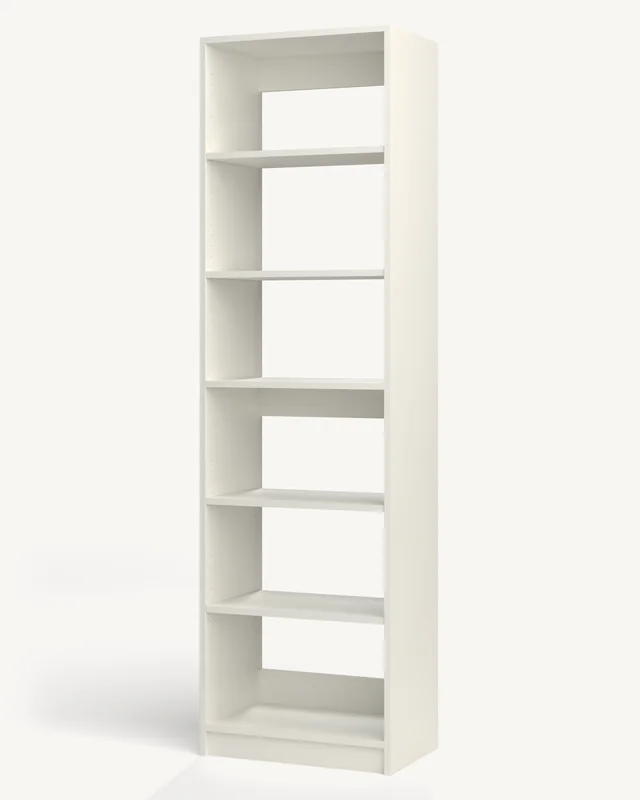
Every cabinet we build is a top half over a bottom half, with a fixed shelf between them, in one of 21 interiors: a rod, shelves or shoe shelves on top, over drawers, a rod, shelves or shoe shelves below. Two have a fixed shelf over the rod, and one hangs full height with no shelf in the middle. Cabinets come 18″ to 33″ wide, so a wall is a row of them side by side, each doing one job.
That makes planning a closet simple: decide what each stretch of wall is for, and pick the interior that does it.
Hanging: double hang or long hang
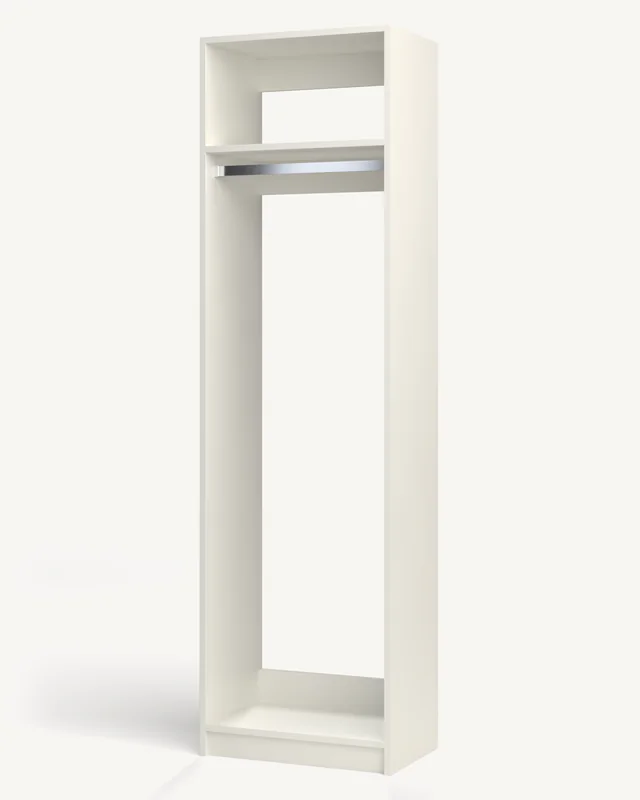
Most of what people hang is short. A shirt, a jacket or a pair of trousers folded over a hanger takes roughly three feet of drop for most adults, which is why double hang, one rod over another, is the workhorse of a good closet. On the same width of wall it gives you twice the bar.
Long pieces need one cabinet with a long drop: a dress, a long coat, a robe. You rarely need more than one of these per person. Here is how much clear hanging each interior gives, from the bar down to whatever is under it:
| Interior | Clear hanging at 84″ tall | At 92-5/8″ tall |
|---|---|---|
| Full-Height Hanging Rod with Fixed Shelf | 64-3/4″, 12″ over the fixed shelf | 73-3/8″, 12″ over the fixed shelf |
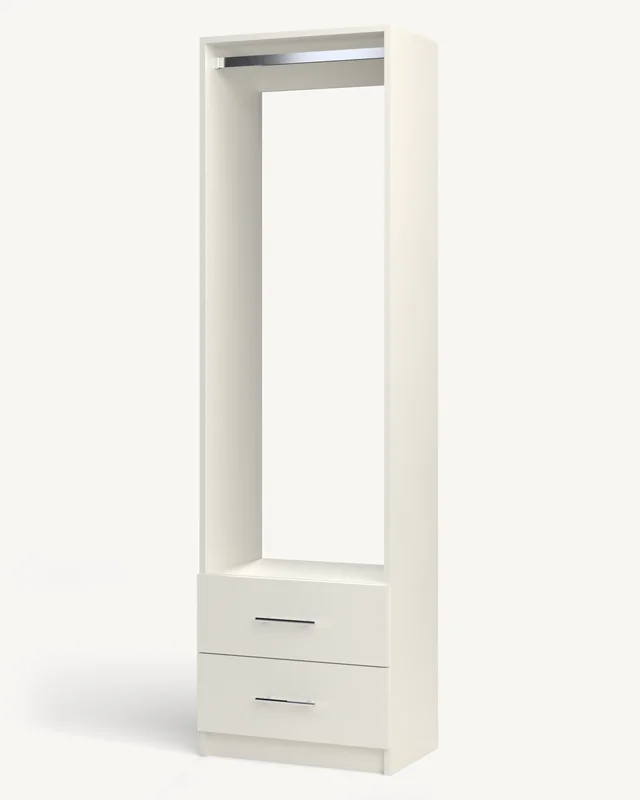
| Rod over 2 Drawer | 59-13/16″ | 68-7/16″ |
| Rod over 3 Drawer | 50-5/8″ | 59-1/4″ |
| Rod + Fixed Shelf over 2 Drawer | 47-1/16″, 12″ over the fixed shelf | 55-11/16″, 12″ over the fixed shelf |
| Rod over 4 Drawer | 41-1/2″ | 50-1/8″ |
| Rod + Fixed Shelf over 3 Drawer | 37-7/8″, 12″ over the fixed shelf | 46-1/2″, 12″ over the fixed shelf |
| Shelves over Rod | 37-3/8″ | 41-11/16″ |
| Shoe Storage over Rod | 37-3/8″ | 41-11/16″ |
| Rod over Rod | 37-3/8″ under each bar | 41-11/16″ under each bar |
| Rod over Shelves | 37-3/8″ | 41-11/16″ |
| Rod over Shoe Storage | 37-3/8″ | 41-11/16″ |
From the bar down to whatever is under it: the shelf, the drawer bank or the bottom of the cabinet. On a 16″ reach-in module; the width doesn’t change it.
Two things to know. The rod in each interior is at a fixed height, set where it works for that interior, so pick the interior for the drop you need. And a taller cabinet gives longer hanging: every interior has more drop at 92-5/8″ than at 84″.
Drawers: what folds and what’s small
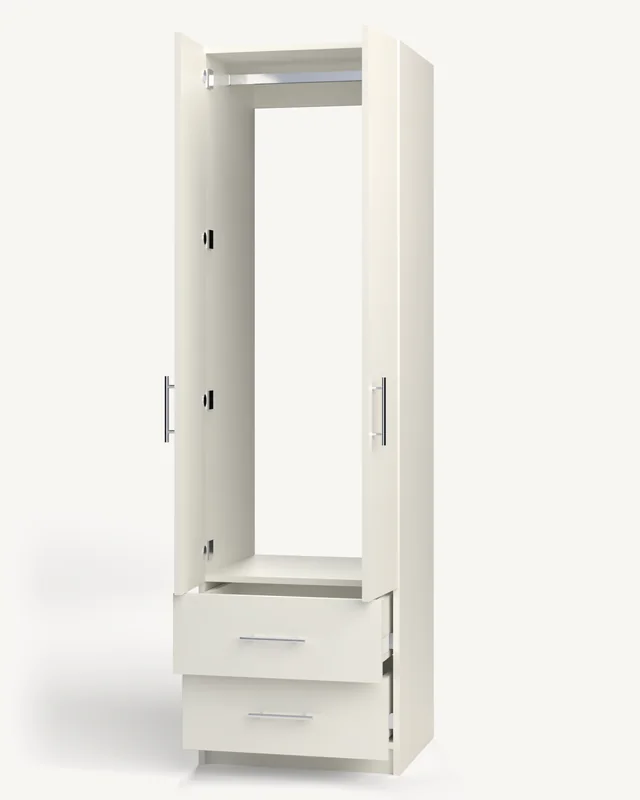
Drawers keep folded clothes and small things out of the dust and out of sight. In a 24″ wide cabinet each drawer is 20 × 12-3/8 × 5-7/8″ inside on a 16″ reach-in module, and 20 × 18-1/4 × 5-7/8″ on a 22″ wardrobe cabinet: a stack of t-shirts or jeans, or a row of rolled socks. Every drawer runs on soft-close slides that pull all the way out, rated for 100 pounds.
Choose two, three or four drawers under a rod or shelves. More drawers means less height above them: over two drawers a rod has 59-13/16″ clear at 84″, over four it has 41-1/2″. One drawer cabinet per person is a good start; two if most of your clothes fold.
Shelves: folded stacks, bags and boxes
Adjustable shelves sit on four pins each, and you move them whenever you like. On a 24″ wide reach-in module each shelf is 22-3/8 × 15-1/8″; on a wardrobe cabinet, 22-3/8 × 21-1/8″. Sweaters are happiest on shelves, in stacks of three or four, because they stretch on hangers. Bags, hats and storage boxes go on the shelves you reach least.
The shelves nearest the floor and the top of the cabinet are the places to keep what you use a few times a year.
Shoes
Our shoe shelves are tilted toward you, so you see the toe of every pair, and each has a fence along the front edge so nothing slides off. They sit on the same pins as a shelf, with the back pins higher than the front, and you can move them as your shoes change. A Shoe Storage over Shoe Storage cabinet at 84″ tall holds 8 shoe shelves, each 22-3/8″ wide.
Tall boots don’t fit between shoe shelves; give them a flat shelf, or the floor of a long-hang cabinet.
Put things where you reach
The best closets put the things you use every day between your knees and your shoulders: today’s shirts on the lower rod of a double hang, the drawers you open each morning at the top of the bank. Above head height and down by the floor is for what you use less.
In a reach-in closet, the cabinets at each end sit behind the short walls beside the door, where they are hardest to get at. Give them shelves for off-season things, and put the hanging you use most in the middle, in front of the door.
Three layouts to start from
A 6′ reach-in for one person (about 72″ wide): Rod over Rod, Rod over 3 Drawer and Shoe Storage over Shelves, each 24″ wide. Double hang for most of the wardrobe, one long-ish drop over drawers, and the shoes in one place.
An 8′ reach-in for two (about 96″ wide): Rod over Rod at each end, with a Full-Height Hanging Rod with Fixed Shelf and a Shelves over 4 Drawer between them. Each person gets a double-hang cabinet, and they share the long hang and the drawers.
A walk-in: double hang and long hang on the back wall, where you see it as you walk in, drawers and shoes on the side walls. Planning a walk-in closet explains the corners.
Treat these as a start. The Closet Builder lets you swap any cabinet for another interior and shows the price as you go, and every interior has its own page on reach-in closets and wardrobe cabinets.
Questions we get
What is double hang in a closet?
Two rods, one above the other, in the same cabinet. It doubles the hanging on the same wall, for shirts, jackets and trousers folded over a hanger. Our Rod over Rod has 37-3/8″ clear under each bar at 84″ tall, 41-11/16″ at 92-5/8″.
How much clear height do I need for long dresses?
Measure your longest piece on its hanger, from the top of the rod to the hem, and add a couple of inches. Our Full-Height Hanging Rod with Fixed Shelf gives 64-3/4″ at 84″ tall and 73-3/8″ at 92-5/8″.
Can I move the shelves later?
Yes. Shelves and shoe shelves sit on pins and move whenever you like. The rods are at a fixed height, set by the interior you choose.
How many drawers should a closet have?
One cabinet of drawers per person is a good start, and two if most of your clothes fold rather than hang. You can put two, three or four drawers under a rod or shelves.
Ready to plan yours?
Lay out your closet cabinet by cabinet and see it priced live, built to the measurements you give us.